Countries served and transit times
Europe for dealerships, traders and rental companies
Vehicle transport across Europe, between businesses
Request free quoteEuropean Administrative Service
Our multilingual team manages all administrative aspects of your transports across Europe. Communication in English, German and French, and expertise of European regulations.
Document management
- ✓Seller contact in Europe
- ✓Document verification
- ✓Administrative processing
- ✓Delivery to Europe
Multilingual communication
- ✓English
- ✓German
- ✓French
- ✓Translation of administrative documents
- ✓Simplified international coordination
Guarantees
- ✓CMR cover included — ad valorem optional
- ✓A tracking link per shipment
- ✓Responsive support
How we work
Seller contact in Europe
Communication in English, German and French
Document verification
Check all paperwork
Administrative processing
Secure legal documents
Delivery to Europe
Buyer contact
Request your quote
Vehicle transport across Europe
The HTL European network: all of Europe, one owned fleet
Everything starts in Düsseldorf, and we move vehicles across the whole of Europe. It is not evenly spread: the Germany – France – Benelux – Denmark axis is the core, Italy, Spain and Portugal run regularly, and the rest of the continent is handled on request. The Rhineland, Benelux and eastern France come up most often in our planning, whereas a run to the Iberian peninsula is built load by load around one firm departure date, and needs more notice.
Switzerland is, as a rule, absent from our routings: Alpine crossings go by the Brenner or the Fréjus, which keeps the LSVA and its paperwork out of it.
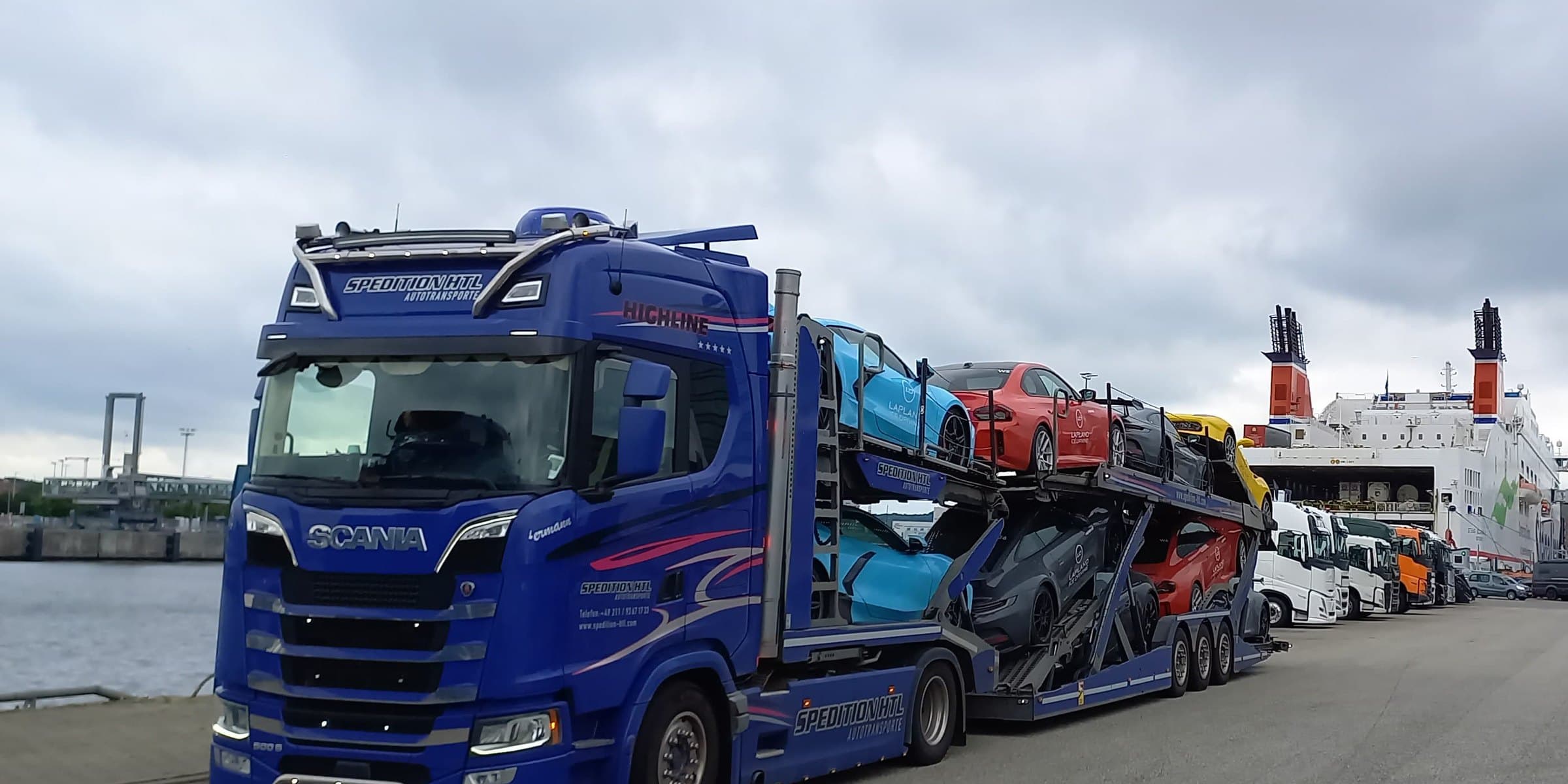
Our customers are first and foremost dealer groups, traders, remarketing platforms, rental companies and brokers. We also move vehicles for private owners, with priority given to trade flows. Their business sets the tempo: a fleet buy-back is not planned like a single retail sale. 47 trucks are on our planning every day with our certified partners, and HTL remains the contractual carrier; five of them have been car carriers of our own since 2014. Every transit time is a working estimate, fixed only when the quotation is issued, and every shipment comes with its own tracking link, no account and no password: the map opens at loading and places the truck within an approach zone of roughly 10 km. The exact position is still available from your contact.
Contractual carrier, not a broker
47 trucks run on our planning every day with our certified partners: on every consignment HTL remains the contractual carrier, liable under CMR, including when a partner drives. Five of them are car carriers of our own, owned since 2014. A broker introduces you, hands the transport to a third party and steps out of the contract — you no longer know who answers.
Carrier or broker: what changes for youTransit times by corridor, from collection to delivery
Measured on 12 months of real loads, grid validated in September 2026. These are end-to-end times, not driving times: they include building the load. Indicative, confirmed on the quotation, never guaranteed.
| Corridor | Transit time (working days) |
|---|---|
| France → Germany | 1 to 3 |
| Germany → France | 1 to 3 |
| France → Spain | 1 to 3 |
| Spain → France | 1 to 3 |
| France → Italy | 1 to 3 |
| Italy → France | 1 to 3 |
| Germany → Spain | 4 to 6 |
| Germany → Italy | 1 to 3 |
| France → Belgium | 1 to 3 |
| France → Netherlands | 1 to 3 |
| Germany → Belgium | 1 to 2 |
| Belgium → Germany | 1 to 3 |
| Germany → Netherlands | 1 to 3 |
| Netherlands → Germany | 1 to 3 |
| France → Portugal | 4 to 6 |
| France → Denmark | 3 to 5 |
| Denmark → France | 3 to 5 |
| Germany → Denmark | 1 to 3 |
| Denmark → Germany | 1 to 3 |
| Germany → Switzerland | 1 to 2 |
| Switzerland → Germany | 1 to 2 |
Car transport across Europe: how the price is built network-wide
A car carrier bills a rotation, not a straight line. The truck that leaves the Rhineland needs work again somewhere, and that weighs as much as the outbound leg. So identical mileage does not cost the same in each direction: on the northern axes a return load is nearly always there, towards Spain and Portugal it has to be planned, and the quotation says so plainly rather than adding a surcharge later.
Those costs then spread across whatever is genuinely loaded. The deck has 9 slots, and a vehicle's footprint — height, length and width together — assigns one: past roughly 1,750 mm of height the top tier closes and the vehicle spreads out. Hence the scale — Polo 1/9, Golf 1/9, ID.4 1/7, Passat Variant 1/6, ID.Buzz 1/4. Road charges and the German Maut (€0.187–0.473 per km) are already carried in that figure.
The rest is yours to steer. Bring your vehicles onto one relation instead of shipping them one by one; mix the body styles so small cars sit above the saloons; widen the collection period by a few days; and give us the two endpoints with the exact models. We then look through the network for a rotation that already passes your two points.
What Our Customers Say
Google Reviews
Without a doubt, the best transport company I have ever dealt with. Their level of customer service is truly exceptional — professional, attentive, responsive, and always available when needed. They were incredibly fast with both the collection and delivery of my car, and the whole process was smooth and hassle-free from start to finish. I couldn’t be happier with the service and would highly recommend them to anyone looking for a reliable and professional vehicle transport company.
Review posted on Google

Great service! they offer a tracking to follow the transport of your car!
Review posted on Google

They have been a regular carrier for us for over eight years now. It is always a pleasure working with Yves and Wolfgang. Communication is quick and easy, and their prices are fair!
Review posted on Google
Frequently asked questions
Everything you need to know about vehicle transport across Europe
It depends on the corridor: expect 1 to 2 working days of driving on the short northern axes (Germany, France, Benelux) and 2 to 3 towards Italy, Spain and Portugal, plus 3 to 4 days between order confirmation and collection. The end-to-end time, from collection to delivery, is counted separately: Denmark ↔ France 3 to 5 working days, Denmark ↔ Germany 1 to 3, Scandinavia 5 to 6. It also depends on loading points and truck fill rate, and stays indicative, confirmed on the quotation.
First and foremost dealerships, traders, rental companies and import agents — our daily business is vehicle transport between businesses. We also carry vehicles for private customers, with priority given to trade flows.
The cost of a trip is the truck, the driver, the diesel and the tolls and it barely changes with what is loaded. The price per car is that cost divided by the number of vehicles on board. Our carrier is worth 9 slots and a vehicle’s overall size — height, length and width together — decides: a Polo takes 1 slot in 9, an ID.4 1 in 7, an ID.Buzz 1 in 4. A single car on a dedicated truck is therefore the most expensive case; the same car on a fully booked truck costs a fraction. To bring the price down: consolidate several vehicles, mix the sizes, stay flexible on the date, and give the models rather than just the count. Reply within 2 working hours, firm price confirmed after checking addresses and date, no commitment.
Within the EU, no customs formalities. Prepare the registration certificate, a proof of ownership or invoice if applicable, and the contact details for pick-up and delivery. A CMR consignment note and a condition report are issued at collection.
Yes. At loading you receive a written confirmation and a tracking link for your shipment, with no account and no password: it places the truck within an approach zone of about 10 km and shows the kilometres left. If you would rather just ask, your contact will give you the position and the estimated delivery.
Yes. Your vehicles are covered by our insurance throughout the transport; the coverage details are specified in your quote.
Not ourselves: your vehicles travel on the carrier, without a single kilometre added to the odometer. We still take driven-delivery requests: a partner provider then drives the vehicle. Just mention it in your quote request or message.
More on this: how the price of a car transport is calculated →