European Administrative Service
Car transport Germany → Italy: allow 1 to 3 working days between collection and delivery, indicative and confirmed on the quotation. Across our whole network, prices start from €200 excl. VAT per vehicle; on long journeys they are usually higher.
Document management
- ✓Seller contact in Germany
- ✓Document verification
- ✓Administrative processing
- ✓Delivery to Italy
Multilingual communication
- ✓English
- ✓German
- ✓French
- ✓Translation of administrative documents
- ✓Simplified international coordination
Guarantees
- ✓CMR cover included — ad valorem optional
- ✓A tracking link per shipment
- ✓Responsive support
Our Germany-Italy process
Seller contact in Germany
Communication in English, German and French
Document verification
Check all paperwork
Administrative processing
Secure legal documents
Delivery to Italy
Buyer contact
Request your quote
Transport Germany - Italy
Alpine transit on the Germany → Italy corridor
Transit runs via the Fréjus tunnel or the Brenner depending on the loading point and the weather, generally avoiding Switzerland. That avoids the LSVA, but means working around Austrian driving bans and winter pass closures — both are factored into the lead time quoted.
The dominant flows are new and demonstration vehicles towards Italian networks, and used vehicles coming back to Germany. For a load in the Rhineland heading to the Po Valley, allow around 2 working days in transit.
Contractual carrier, not a broker
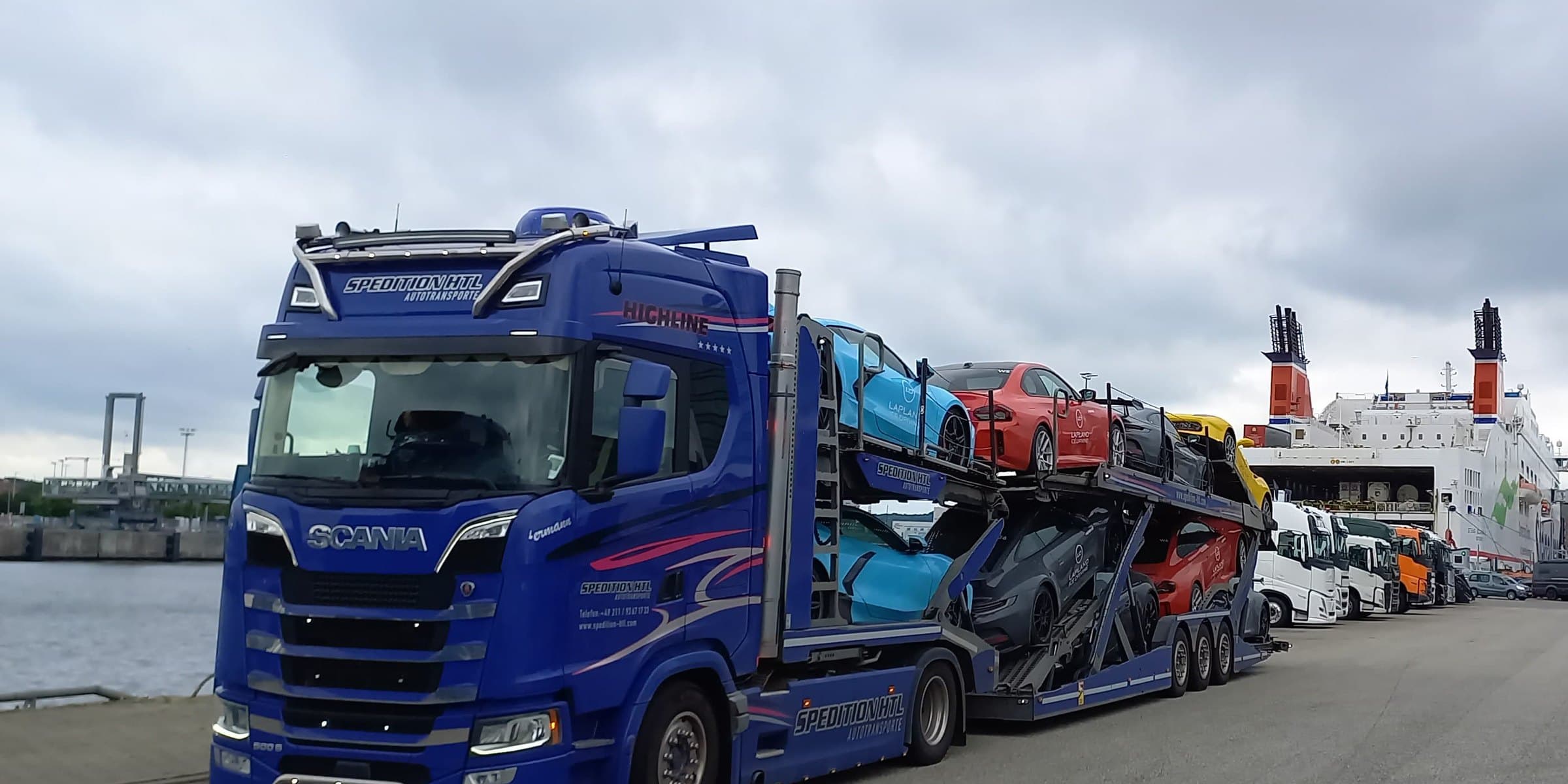
47 trucks run on our planning every day with our certified partners: on every consignment HTL remains the contractual carrier, liable under CMR, including when a partner drives. Five of them are car carriers of our own, owned since 2014. A broker introduces you, hands the transport to a third party and steps out of the contract — you no longer know who answers.
Carrier or broker: what changes for youTransit times Germany → Italy
Allow 1 to 3 working days between collection and delivery.
That is an end-to-end time, not a driving time: it includes building the load and the delivery slots, not just the road. Add 3 to 4 days between order confirmation and collection.
Indicative, confirmed on the quotation, never guaranteed — measured on 12 months of real loads, grid validated in September 2026. All transit times by corridor →
Germany → Italy car transport: why filling the deck sets the price
Two identical trucks do not cost the same per kilometre on this corridor, which is exactly where a per-kilometre rate breaks. The German Maut runs from €0.187 to €0.473 per km depending on emission class and axle count. On top of that come, depending on the route chosen, either Austrian transit over the Brenner or the tunnel toll on the Fréjus side, plus the Italian toll motorways. A whole trip is costed, then spread across the vehicles loaded.
New and demonstration vehicles heading for Italian networks rarely arrive in a single format. The carrier has 9 slots, allocated by height and never by length: above roughly 1,750 mm a vehicle stays on the lower deck. A Polo counts 1 slot in 9, a Golf 1 in 9, an ID.4 1 in 7, a Passat Variant 1 in 6, an ID.Buzz 1 in 4. A half-loaded truck costs the same as a full one.
One lever really counts here, and it is yours: the loading window. Austrian driving bans, winter pass closures and the choice between the Brenner and Fréjus — Switzerland generally left out — routinely move a trip by a day or two. Two days of slack is usually enough to put you on a rotation already running rather than opening a new one. Name the exact models as well: there is no honest way to price without them.
What Our Customers Say
Google Reviews
Without a doubt, the best transport company I have ever dealt with. Their level of customer service is truly exceptional — professional, attentive, responsive, and always available when needed. They were incredibly fast with both the collection and delivery of my car, and the whole process was smooth and hassle-free from start to finish. I couldn’t be happier with the service and would highly recommend them to anyone looking for a reliable and professional vehicle transport company.
Review posted on Google

Great service! they offer a tracking to follow the transport of your car!
Review posted on Google

They have been a regular carrier for us for over eight years now. It is always a pleasure working with Yves and Wolfgang. Communication is quick and easy, and their prices are fair!
Review posted on Google
Frequently asked questions
Everything you need to know about transport Germany - Italy
Allow 1 to 3 working days between collection and delivery. This time depends on loading points, truck fill rate and delivery windows: it is indicative and confirmed on the quotation.
The cost of a trip is the truck, the driver, the diesel and the tolls (around 1100 km on this route) and it barely changes with what is loaded. The price per car is that cost divided by the number of vehicles on board. Our carrier is worth 9 slots and a vehicle’s overall size — height, length and width together — decides: a Polo takes 1 slot in 9, an ID.4 1 in 7, an ID.Buzz 1 in 4. A single car on a dedicated truck is therefore the most expensive case; the same car on a fully booked truck costs a fraction. To bring the price down: consolidate several vehicles, mix the sizes, stay flexible on the date, and give the models rather than just the count. Reply within 2 working hours, firm price confirmed after checking addresses and date, no commitment.
Within the EU, no customs formalities. Prepare the registration certificate, a proof of ownership or invoice if applicable, and the contact details for pick-up and delivery. A CMR consignment note and a condition report are issued at collection.
Yes. At loading you receive a written confirmation and a tracking link for your shipment, with no account and no password: it places the truck within an approach zone of about 10 km and shows the kilometres left. If you would rather just ask, your contact will give you the position and the estimated delivery.
Yes. Your vehicles are covered by our insurance throughout the transport; the coverage details are specified in your quote.
Not ourselves: your vehicles travel on the carrier, without a single kilometre added to the odometer. We still take driven-delivery requests: a partner provider then drives the vehicle. Just mention it in your quote request or message.
Across our whole network, prices start from €200 excl. VAT per vehicle. On long journeys the price is usually above this floor: the online estimate or the quote gives you yours, for your route and your models. Whether we cross via the Brenner or the Fréjus depends on Austrian driving bans and winter pass closures: two days of slack on the loading date is usually enough to catch a run already in progress. The exact price depends on the models declared: enter your route on the site for a real range immediately.
More on this: how the price of a car transport is calculated →