Buying a car in Germany and importing it into France: paperwork and transport
· 9 min readRegulation
Procedures checked on 15/11/2026 — the official page prevails. Buying a car in Germany to register it in France always follows the same order: check the car and the seller, gather the German papers, bring the car over, then complete the French formalities. This guide follows that order. We are a vehicle carrier and take part in one step only, the transport: the formalities stay yours, and each one points here to the official page that describes it.
For traders and dealers
Buying in Germany to resell in France? The steps are the same as for a private buyer, with two points specific to businesses. VAT first: between businesses the rules differ from a private purchase, and Your Europe refers to its page on business-to-business transactions for them. Then the VAT number: a German seller’s number can be checked with the European VIES tool, and the German Federal Central Tax Office (BZSt) lets German businesses check yours. For the French tax certificate (quitus fiscal), service-public states that a motor trade professional can, depending on the buyer’s département, apply online on the ANTS website.
For transport, we take vehicles as a single vehicle, partial load or full load. Our page on used-vehicle transport for traders explains how we work with dealers, and you can send us your vehicle list for a quote.
Before you buy: the car, the seller, what to ask for
The French formalities start with the advert. For the tax certificate, impots.gouv.fr requires an invoice (trade seller) or a transfer certificate (private seller) stating, among other things, the seller — with their VAT number if a business —, the chassis serial number, the date of first registration and the actual mileage. Ask for this document, complete, at the time of sale.
Ask for the European certificate of conformity (COC) too. Service-public describes it as proof that European standards were met when the vehicle was built; without it, or an EC type identification certificate, an individual approval (réception à titre isolé) from the regional authority (Dreal) is needed. It is usually supplied by the seller and can be obtained from the manufacturer (service-public).
Private or trade seller: it matters for VAT. According to service-public, a used car bought from a private seller carries no VAT; bought used from a dealer, the VAT of the country of purchase applies, with no further VAT in France; a new car pays VAT in France. Your Europe gives the age and mileage criteria that make a car “new” for VAT, and advises, for a new car to be registered in another country, informing the dealer so you do not pay VAT in the country of purchase.
Lastly, what the seller says counts: Your Europe points out that a used car bought from a dealer in another EU country must match the seller’s description. Keep the advert and what was said about the car’s condition in writing.
The German vehicle papers
A vehicle registered in Germany has two documents: the Zulassungsbescheinigung Teil I (formerly Fahrzeugschein) and the Zulassungsbescheinigung Teil II (formerly Fahrzeugbrief), according to the Federal Motor Transport Authority (KBA). Older documents stay valid until the next change recorded on the vehicle, such as a change of keeper, so you may still come across a Fahrzeugbrief.
Do not leave without them. Both parts are required for German export plates (see below), and French registration requires the original registration certificate, an official proof of ownership or, if the German authorities kept it, an official document saying so (service-public).
The vehicle can also be deregistered in Germany (Außerbetriebsetzung, or Abmeldung) with the registration authority; the Federal Ministry of Transport says this can be done online. One consequence matters next: once deregistered, the vehicle may no longer be driven or parked on public roads (Federal administration portal).
Bringing the car over: by road or by truck
By road, the car needs plates that are valid for the whole journey. Service-public notes that on entering France the vehicle must carry valid registration plates, and Your Europe that driving home on your old car’s plates is illegal. In Germany, short-term plates (Kurzzeitkennzeichen) are valid only inside the country (Federal portal); to take a vehicle abroad, you need export plates (Ausfuhrkennzeichen).
Export plates are applied for at the registration authority, and the conditions depend on the region. The Hamburg entry on the Federal portal, for example, asks for an insurance confirmation for export plates, both parts of the Zulassungsbescheinigung, a power of attorney when the keeper does not apply in person and, for an applicant not resident in Germany, a local authorised recipient; the plates are valid only for the period applied for. Your Europe adds that temporary plates are not mutually recognised within the EU: check that every country you drive through accepts them, with insurance valid in all of them.
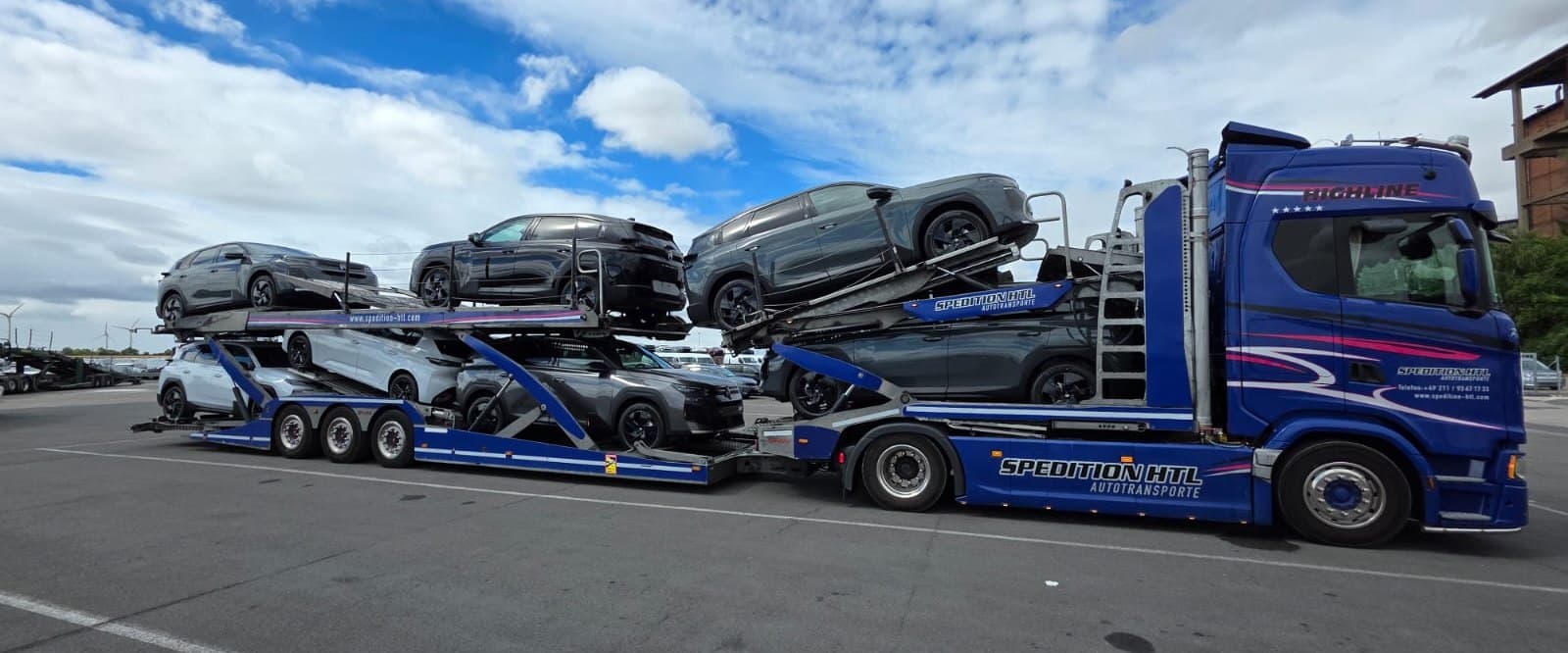
By car carrier, the car is loaded at collection and unloaded on arrival: it is not driven on the road during the journey, which also holds for a car that has already been deregistered. What you need to arrange is different: someone at the seller’s for the collection, or an authorisation that lets our driver take the vehicle in your name — we draw up that collection authorisation and send it to the collection site; the keys and the vehicle papers; a reachable contact at delivery. And whichever way you choose, service-public reminds you that the car must be insured from its arrival in France.
This is the step where we come in. We have more than 40 trucks on our planning with our certified partners — HTL stays the contractual carrier (CMR) — five of them car carriers of our own, and we run open car carriers. Trade customers have priority; private customers are welcome too. Our Germany → France car transport page presents this route, and the quote form takes your journey.
What HTL does, and does not do
HTL transports the car as the contractual carrier: we are liable under the CMR for every consignment, including those a partner drives, with one contact from quote to delivery. At collection, we draw up the CMR consignment note and a condition report with a damage diagram and photographs.
HTL does not handle the administrative formalities: not the German deregistration, the plates, the tax certificate or the French registration. We do not buy the car for you and we do not inspect it before purchase: the condition report at collection describes the car when we take it over; it is not an expert appraisal. These formalities are the buyer’s.
On arrival in France: the tax certificate, then registration
First step: the tax certificate (quitus fiscal, or certificat fiscal), which certifies that the vehicle is in order regarding VAT. It belongs to the tax authorities, not customs: between EU countries, a private individual pays no customs duty (service-public). It is requested after delivery of the vehicle, and the registration application can only be made on presenting it (impots.gouv.fr).
Depending on your département, the application goes through an online procedure that combines tax certificate and registration on the ANTS website, or by email to the competent tax office with form no. 1993-PART-D-SD. The documents: proof of address in France, the buyer’s ID, the foreign registration certificate if the vehicle was already registered, a detailed invoice or transfer certificate, and a mandate if you are not the buyer. A certified translation may be requested if the invoice or registration certificate is not in French (impots.gouv.fr).
Second step: the French registration certificate (certificat d’immatriculation, formerly carte grise), applied for online on the ANTS website (service-public). For a vehicle registered in another EU country, the list includes among others the original registration certificate or an official proof of ownership, proof of address, proof of roadworthiness testing unless exempt, the tax certificate, the transfer certificate or invoice, and proof of conformity — COC, type identification certificate or individual approval. You also certify on your honour that you hold insurance and the matching driving licence.
Roadworthiness testing depends on the vehicle’s age, and service-public sets out the conditions; for a vehicle previously registered in an EU country, a test carried out in the EU is accepted (service-public). The cost of registration depends on the vehicle and the region: service-public refers to an official calculator, and some vehicles may be subject to taxes based on their CO2 emissions (service-public).
The documents at a glance
German side, before the car leaves: Zulassungsbescheinigung Teil I and Teil II (or the older Fahrzeugschein and Fahrzeugbrief), a complete invoice or transfer certificate, the European certificate of conformity (COC) if there is one and, if the car comes home by road, export plates with their insurance confirmation.
French side, for the tax certificate: proof of address, ID, foreign registration certificate, invoice or transfer certificate, mandate if applicable. For registration: the documents on the service-public list, including the tax certificate, proof of roadworthiness testing unless exempt and proof of conformity.
For transport by truck: the exact collection and delivery addresses, a reachable contact at each end, the model and the VIN, the keys and the vehicle papers.
Sources (pages read on 15/11/2026)
France: Quelles obligations pour immatriculer un véhicule acheté à l’étranger ?, Acheter un véhicule en Europe : quelles formalités douanières ?, Certificat d’immatriculation : immatriculer un véhicule d’occasion and Peut-on faire le contrôle technique à l’étranger ? (service-public.gouv.fr, in French); Vous êtes un particulier et vous souhaitez obtenir un quitus fiscal (impots.gouv.fr, in French).
European Union: VAT when buying or selling a car abroad, Buying and leasing a car in another EU country (FAQ) and Check a VAT number (VIES) (Your Europe).
Germany: Zulassungsdokumente (KBA); internetbasierte Fahrzeugzulassung (Federal Ministry of Transport); Ausfuhrkennzeichen, Kurzzeitkennzeichen and Außerbetriebsetzung (Federal portal, Hamburg entries); Bestätigung ausländischer USt-IdNrn (BZSt). These pages change: the official page prevails.