Documents and collection date: preparing a Germany–France transport
· 7 min read · Updated on
Germany to France is the oldest and busiest lane we run, and the one where buyers ask the most precise questions: when exactly does the truck come, what is included in the price, and what has to be ready at the collection site. This is a corridor of dealer stock, leasing returns and auction purchases, worked daily from North Rhine-Westphalia towards the Paris region, Lyon and Grand Est. Below: the real timings, the German Maut and French tolls and how they sit in a quotation, the documents that travel with the vehicle, and what actually moves a collection date.
The oldest and busiest lane in our network
Most rotations start in North Rhine-Westphalia — Düsseldorf, Cologne, the Ruhr — and run towards the Paris region, the Lyon area and Grand Est. The truck stays on the German and then the French motorway network, with no intermediate storage and no Swiss transit, which keeps the Swiss road charge and the constraints of Alpine transit out of the trip. Return traffic from France to Germany follows the same roads.
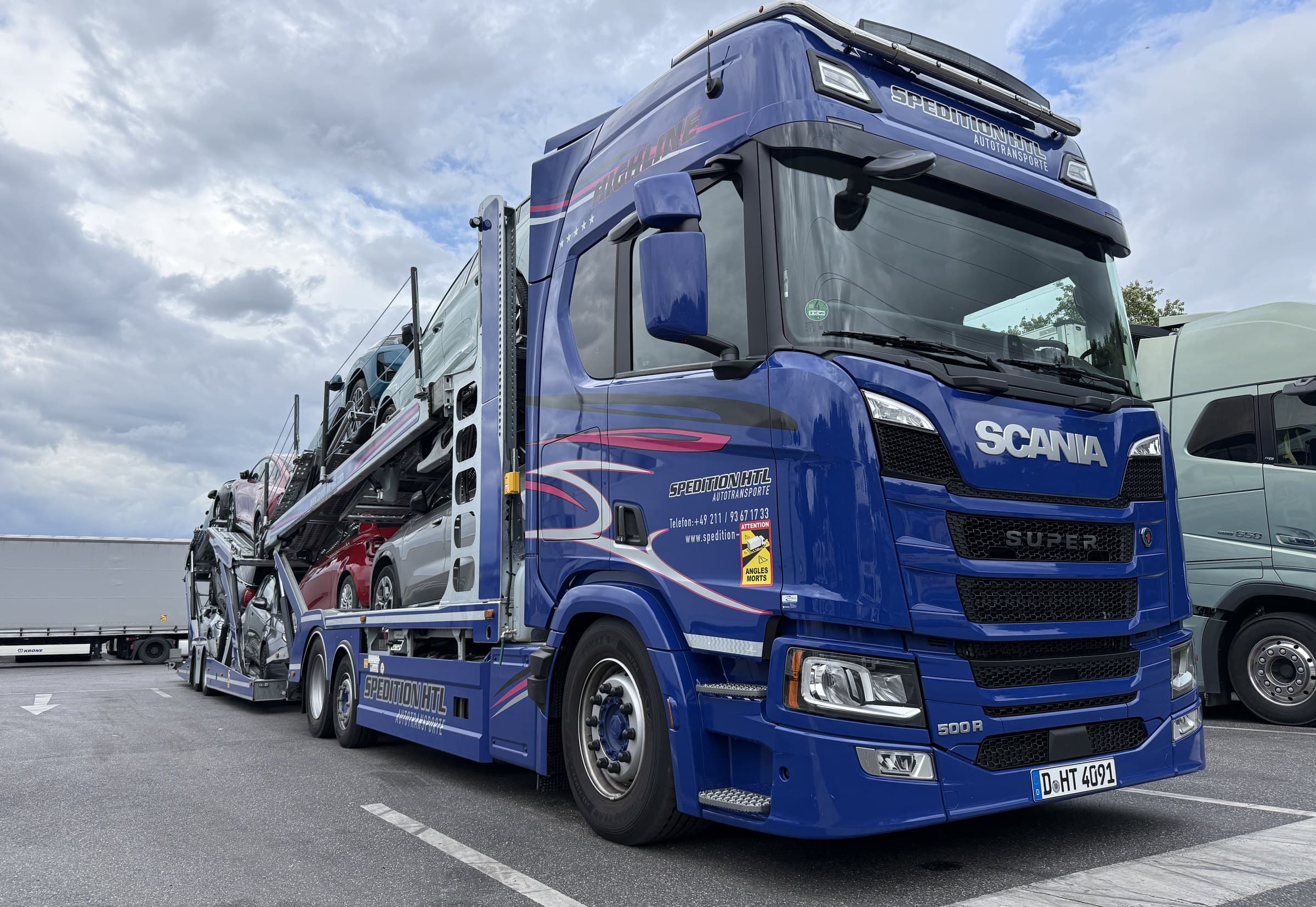
Collections are split between three kinds of site: dealer groups moving stock, remarketing platforms clearing leasing and rental returns, and German auction yards where French buyers pick up cars they have never seen. The customers are mostly trade — traders repatriating German stock, rental fleets rebalancing, distribution groups shifting cars between their own sites. Private customers are accepted, with trade flows taking priority on the schedule. Volumes range from a handful of cars filling part of a deck to a full load — the whole truck, six to nine vehicles depending on their height. Transport runs on open car carriers; enclosed trailers are not run by our own fleet, we place them with specialised partners on request.
The team is natively French-German. A call to a German seller happens in German, with no translation step in between; a call to the French consignee happens in French. On a batch bought at auction or through a remarketing platform, that is what keeps the expensive misunderstandings away: a collection address taken down wrong, a condition report loosely translated, a contact who never calls back because someone reached him in the wrong language.
HTL owns five car carriers and runs the rest of the schedule with certified partners — around a hundred trucks moved as demand requires. None of that changes where you stand contractually: HTL takes the order and remains the contractual carrier (Frachtführer), liable under CMR on every consignment, including those a partner drives. A broker introduces two parties, hands the transport to a third and leaves the contract. That is the real difference, and it was never a question of how many trucks anyone owns.
How long it actually takes
Two clocks run on this corridor, and mixing them up is where most disappointment comes from. The first starts when you confirm the quotation and ends when the truck is at the collection point: allow 3 to 4 days. That window is not idle time. It is where dispatch finds the trip your vehicles fit into, agrees a slot with the collection site, checks that the keys and the papers will be there, and, on an auction pick-up, waits for the release to actually be issued. The second clock is the road itself: on the short northern corridors — Germany, France, Benelux — the drive is 1 to 2 working days once the vehicles are loaded.
End to end, a Germany–France move therefore usually lands within the week following confirmation. The two figures do not simply add up, though. A collection in the Rhineland delivered in the Paris region does not take the same time on the road as a load in Bavaria delivered to Toulouse. Actual distance, the number of collection points and the driver's statutory driving hours all feed into it, which is why nobody serious quotes a duration before seeing the addresses.
Both figures are indicative and confirmed on the quotation — never guaranteed. A carrier who guarantees a date on an international road move is guaranteeing something he does not control: a closed motorway, a missing key, a dealership that shuts at noon. What you do get is visibility. Each transport comes with its own tracking link, no account and no password. It goes live once the vehicles are loaded, not before — while the car is still at the seller's there is simply nothing to follow — and it shows an approach zone of roughly ten kilometres rather than an exact point.
The German Maut and the French tolls
The Maut is Germany's distance-based truck toll. It applies on motorways and federal roads, is collected automatically through an on-board unit, and is tiered by emission class and axle count. The published scale runs from €0.187 to €0.473 per kilometre. The top of the band is more than double the bottom: on the very same route, a modern carrier in a favourable emission class pays considerably less per kilometre than an older rig. It is a real cost line on a Germany–France run, not a rounding error, and it is structural rather than negotiable.
France works differently. Its motorways are largely concession-operated and billed section by section at the barrier, by vehicle class; heavy goods vehicles fall into class 4, which is not the top band of the scale. There are also toll-free sections, particularly in the north and around the conurbations, so two runs of the same length can cost different amounts depending on which sections they use. What sets the figure is the routing, not the mileage alone — and it depends on the truck and the road taken, never on what is loaded on top.
Both are built into the quotation and never invoiced afterwards. Fuel and CMR cover are included on the same basis. We keep it that way because items added later make a buyer's costing useless: a price that is topped up afterwards with tolls, diesel or waiting time was never a price, only an estimate.
The documents that travel with the vehicle
The CMR consignment note is the spine of the file. It names the sender, the carrier, the consignee and the vehicles, and it is signed twice: at collection and at delivery. Attached to it is the condition report, with a damage diagram backed by photographs, drawn at departure and taken again on arrival. Without a reservation written at collection, the vehicle is presumed handed over in good order — so scratches, kerbed rims and stone chips are recorded before the truck leaves, and the vehicle is worth inspecting before anyone signs at delivery.
When we collect from a third party — a dealership, an auction yard, a remarketing platform — the site has to know that our driver is entitled to take the vehicle away in your name. That is what the collection authorisation is for. We draw it up and send it to the collection site before the truck is routed; there is nothing for you to prepare. Without it, an auction yard is right to refuse the release and the truck leaves empty — an avoidable failure.
Germany and France are both in the EU, so there is no customs formality on this corridor. What remains is the vehicle's own paperwork: the registration certificate — Fahrzeugbrief and Fahrzeugschein for a German vehicle — and, in the trade, the invoice or proof of ownership. Registering the car in France afterwards calls for further documents, a certificate of conformity among them in some cases; that is the buyer's business, not the carrier's. None of it governs the transport itself, but a missing document blocks the file long after delivery.
What we need from you when you place the order: the exact collection and delivery addresses; a contact who answers the phone at each end, with a number; the models and VINs of the vehicles; the keys and the vehicle papers; and, where it applies, a note that a vehicle does not run — it can then be winched aboard provided it steers and brakes, which has to be stated when you ask for the quotation. An approximate address, or a contact who never picks up, costs more time than any traffic jam. The rest — CMR, damage diagram, photographs, collection authorisation — is our job, not yours.
What moves a collection date
A collection date is not a slot in a calendar; it is the point where several constraints happen to line up. The widest lever is your collection window. A fixed day, on a fixed morning, means dispatch has to build a trip around you. A window of two or three days means we can place your vehicles on a trip already running towards France — which is almost always faster in practice than waiting for a dedicated departure to be assembled.
How the truck fills matters just as much. A carrier leaves when it is loaded; a dedicated trip for a single vehicle stays possible, at a different rate, when the schedule takes priority. It is the height of each vehicle that decides what fits on the upper deck and what has to go below. Telling us the models, not only the number of vehicles, lets dispatch build a real load plan instead of a guess — six city cars do not sit on a truck the way six large SUVs do, and a complete list at enquiry stage saves a re-planned trip three days later.
Direction matters too. Germany to France is the loaded direction on this lane; more vehicles go south-west than come back, so a collection in France for delivery in Germany is best hung on a truck that is heading home anyway. A delivery point sitting on an active return flow moves faster than an isolated one, simply because the truck has somewhere to go next — and an empty return ties up exactly the same resources as a loaded one.
Finally, the calendar. Demand on this corridor concentrates at the end of the month and the end of the quarter, when dealers close registrations and hand cars over, when fleets come back off contract and when the big auctions clear; it thins out over the summer weeks and around the year-end holidays, mainly on the collection side. Three things genuinely help: ask early, give a window rather than an hour, and send a complete vehicle list first time. None of the three costs you anything.