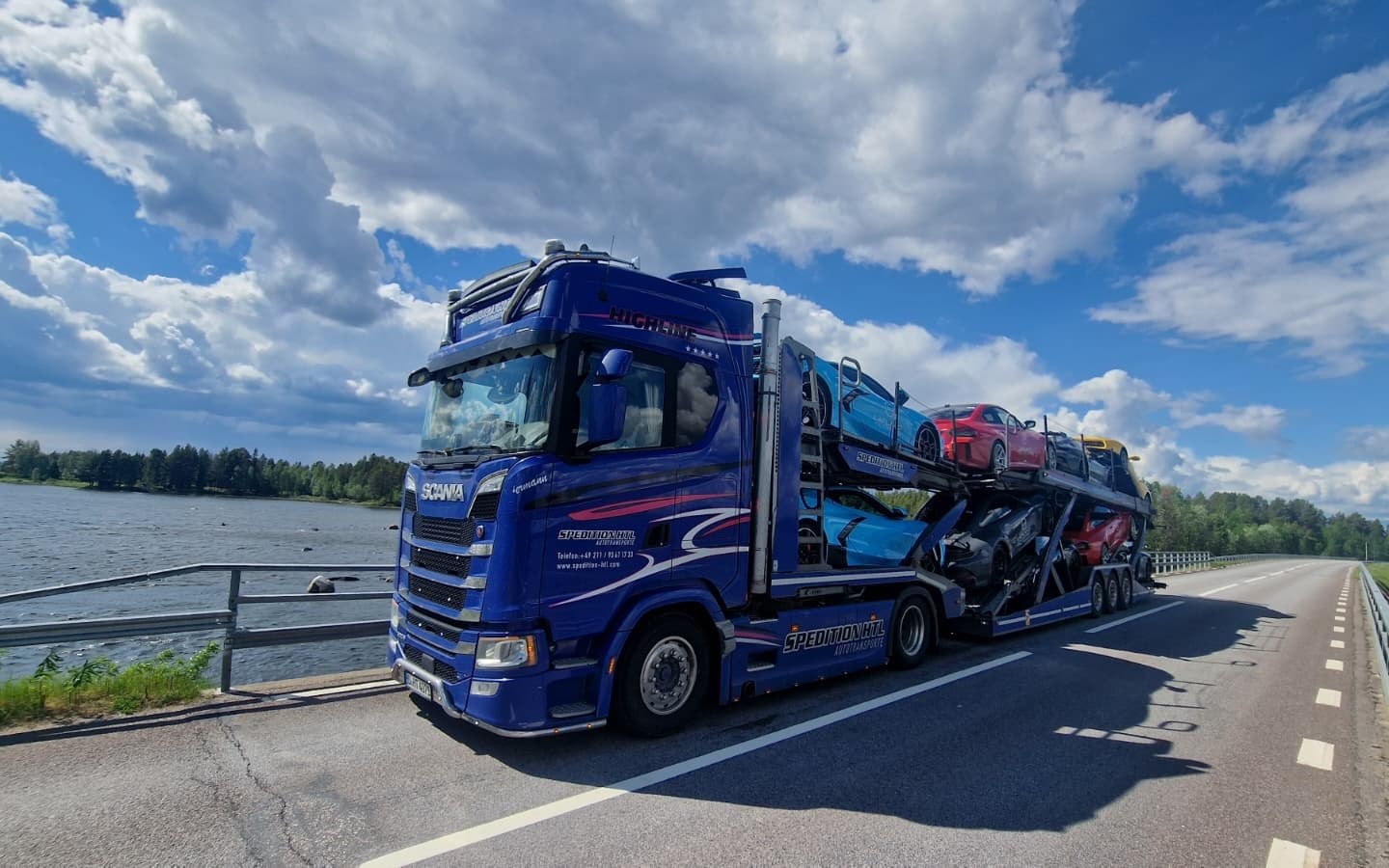
Importing a vehicle from Germany into the Netherlands: collection, papers, BPM
· 6 min read · Updated on
A Dutch dealer buying in Germany is working two markets at once: a sourcing market, where the vehicle usually sits in an auction yard or on a remarketing platform, and a home market, where the same vehicle is worth nothing until it is registered in the Netherlands. Between the two sit a shipment and, above all, a stack of paperwork the rest of the deal hangs on. This article looks at the Germany → Netherlands lane from the importer's side: where the truck collects, what an auction yard requires before it releases anything, which documents travel with the vehicle, what Dutch BPM changes — and does not change — about the transport, and how long the whole thing really takes. The corridor itself is covered in our article “Car transport Germany–Netherlands: time, price, documents”; this one is about importing.
Düsseldorf is an hour from the Dutch border
On the map of our rotations, Germany to the Netherlands is the shortest run we operate. Düsseldorf, where we are based, is an hour from the border: a truck loaded in the Rhineland in the morning unloads in Venlo, Eindhoven, Rotterdam or Amsterdam without the drive itself being an issue. On this lane, allow 1 to 3 working days between loading and delivery, at the bottom of that range. Which means the date is almost never set by the road. It is set by the collection and by the paperwork.
The flows are well known: German used cars and end-of-lease returns going to Dutch traders, dealer groups and platforms, plus new-vehicle deliveries into the local networks. Our customers are mostly trade — traders, dealerships, rental companies, leasing companies, importers, remarketing platforms. Private customers are accepted, with trade flows taking priority on the schedule. The Netherlands is not a full-load-only lane: a few vehicles sharing the same deck is the norm here.
A word on who drives, because the question always comes up when you are buying at a distance. HTL operates five car carriers of its own and covers the rest of its schedule with certified partners — around a hundred trucks in the schedule, as demand requires. What that does not shift is the liability: HTL takes the order, remains the contractual carrier (Frachtführer) and is liable under CMR for the consignment, including when a partner drives it. A broker introduces two parties, hands the transport to a third and steps out of the contract; the difference is contractual — it is about who answers for the vehicle, not about the size of a fleet. We have operated since 2014 under community licence D-05-026-G-125 (Bezirksregierung Düsseldorf), on open car carriers; enclosed transport is placed with specialised partners on request.
Auction yards and remarketing platforms as the collection point
A German import is almost never loaded on somebody's driveway. The collection point is usually a compound, an auction yard or a remarketing platform: a closed site with opening hours, booking slots and its own release desk. The first hurdle there is the release of the vehicle. Until the invoice is settled and the release actually issued, nothing leaves the yard, whichever truck is standing at the gate. On an auction purchase it is very often that release — not the availability of a loading space — that sets the collection date.
The collection authorisation comes next, and in that order: before the release it is of no use, and after the release its absence stops everything. The yard has to be able to check that our driver is taking the vehicle away on your behalf at the same moment it checks that the car is free to go. We draw the document up and get it to the yard ahead of the truck; there is nothing for you to draw up. What we do need from you is the name the lot sits under at the seller's — the auction account, which is not always the company that pays.
The rest comes down to information nobody thinks to send and that costs whole days when it is missing: the address of the yard rather than the head office — the large auction operators run several sites in Germany, and the car is not always where the listing suggests; a contact on site with a direct number; the lot or file reference the yard will find the vehicle under; keys and papers that are genuinely there; the models and VINs rather than a plain car count; and a note when a vehicle does not run. Winch loading is still possible if the vehicle steers and brakes, but that has to be said at enquiry stage, not at the gate.
The documents that travel with the vehicle: CMR, Part II, CoC
The transport document is the CMR consignment note, which we issue and which is signed twice: at collection and on delivery. On an import, though, its real value lies elsewhere — in the damage record backed by photographs taken in the seller's yard. A car bought at auction is one you have usually never seen; that record is its first factual description of condition, made by a third party, on a known date. A reservation that was not entered at loading cannot be added later: the vehicle is deemed to have been received in apparent good order and condition. Which is why, on delivery, you walk around the vehicle first and sign afterwards, not the other way round.
The ownership document is the Zulassungsbescheinigung Teil II, the former Fahrzeugbrief. It is not a transport document — the truck can leave without it. It is, however, the paper a German seller sometimes holds back until payment clears in full, which is exactly why how it reaches you has to be settled before collection: does it travel with the vehicle, or go separately by tracked mail? Tell us as soon as you know. Both are common practice; what is not is finding out on delivery.
That leaves the certificate of conformity (CoC), which evidences conformity with the European type approval. It comes from the manufacturer or the seller, never from the carrier: it is not a transport paper and we do not hold it. Since Germany and the Netherlands are both in the European Union, there is also no customs clearance on this lane. In short: CMR, damage record, photographs and collection authorisation are ours; Part II, CoC, purchase invoice and registration file are yours. The Dutch registration procedure itself reaches beyond transport: it belongs to the RDW, and to a tax adviser for the tax side. We do not describe it here, and nobody should describe it on your behalf.
BPM: what it changes for you, and what it does not change about the transport
BPM is the Dutch tax on putting a passenger car into service in the Netherlands. From the transport side there is exactly one thing to say about it: it is owed by the importer — that is, by you, not by the carrier — at the point of registration in the Netherlands. Our driver collects nothing, hands over no tax paperwork and has no part in it, at loading, on the road or on delivery.
That leaves the only consequence we can responsibly cover here: HTL does not advance BPM and does not invoice it. Our invoice is a transport invoice; the CMR note evidences a movement, not a tax event. We publish no rates, no scales and no calculation method, and we take no view on what the Dutch administration expects: this is tax law, it changes, and an approximate figure on a haulier's website helps nobody. Have a tax adviser calculate the BPM before you buy, or check it with the relevant Dutch authority.
That leaves the mistake that costs the most, and it is not a tax mistake: budgeting an import as “purchase price plus transport”. BPM, registration and the hours spent assembling a file weigh on the landed cost as heavily as the truck does, and they belong before the bid rather than after the delivery. Of that total we fix one part only: the transport price, confirmed on the quotation, tolls included. For everything else, the RDW and a tax adviser — that is their business, not ours.
The real transit time, and what moves it
An import runs on two clocks, never one, and that is where nearly every misunderstanding starts. Between confirmation of the quotation and collection, allow 3 to 4 days: your vehicles have to be placed on a trip, a slot agreed with the site, and keys, papers and release checked to make sure they are really there. Then comes the road: 1 to 3 working days on this lane — at the bottom of that range. Put end to end, most imports therefore land within the week following confirmation. These are indicative figures, confirmed on the quotation, never guaranteed.
Four things move a date, and three of them are yours. A release not yet issued pushes everything else back, whichever truck was scheduled. A collection window of two or three days beats a fixed time: it lets us slot you into a trip already running, which pulls the date forward rather than back. A complete vehicle list at enquiry stage, models and VINs included, saves us replanning three days later. The fourth depends on nobody: the direction of the flow. We run this lane loaded in both directions, which makes a German import easier to schedule than many other routes.
While the vehicle is in transit you get a tracking link for that consignment, no account and no password. Nothing appears on it until the vehicle is loaded — in the seller's yard there is nothing to follow — and from then on it places the truck inside within roughly 10 km rather than on an exact point. On tolls, the German Maut runs as far as the border, at the published rate of €0.187 to €0.473 per km depending on emission class and axle count; on the Dutch side, the heavy-vehicle road charge (vrachtwagenheffing) and a few toll tunnels add to that. All of it sits inside the quotation and is never recharged afterwards.
Go further on this corridor:
See our Germany → Netherlands corridor page →