Diesel prices in 2026: how much do they really affect your vehicle transport?
· 5 min read · Updated on
In late July 2026, European road diesel rose sharply: around +10% in two weeks, including +4.5% in the week to 27 July alone (European Commission Weekly Oil Bulletin). When a transport price moves, the question is fair: where does the difference come from, and how much of it? Here is a figures-based answer.
What happened in late July 2026
The EU average for road diesel went from about €1.75/L on 13 July to €1.92/L on 27 July 2026 — nearly +10% in two weeks (source: European Commission Weekly Oil Bulletin).
The move is confirmed at national level: in France, the CNR professional diesel index rose +5.73% in July (index 242.15). So this is not an artefact of EU averaging, but a real increase on the markets our trucks actually run on.
Country gaps matter as much as the average
A car carrier running Düsseldorf–Paris or Hamburg–Copenhagen does not refuel at the same price everywhere. As of 27 July 2026, pump prices (incl. tax) ranged from about €2.14/L in Belgium to €2.39/L in the Netherlands, with Germany at ~€2.19/L, France at ~€2.17/L and Denmark at ~€2.29/L.
A carrier operating its own trucks optimises refuelling points along the route. Invisible to the client, very real on the final cost — and a fundamental difference from an intermediary buying a service as a flat package.
What share does fuel actually represent?
In car-carrier operations, fuel accounts for roughly 20 to 25% of the daily running cost. The rest is split between driver wages, tractor and trailer depreciation, tolls, insurance and maintenance.
The direct consequence: a 10% rise in diesel does not push a quote up by 10%. Its mechanical effect is closer to 2-2.5%, before any loading optimisation. A useful benchmark to judge whether a price revision is proportionate.
What really absorbs the increase: load factor
Fuel cost is spread across the number of vehicles carried. A carrier running 8 vehicles instead of 5 mechanically dilutes the increase per unit — the gap in unit cost outweighs the movement at the pump.
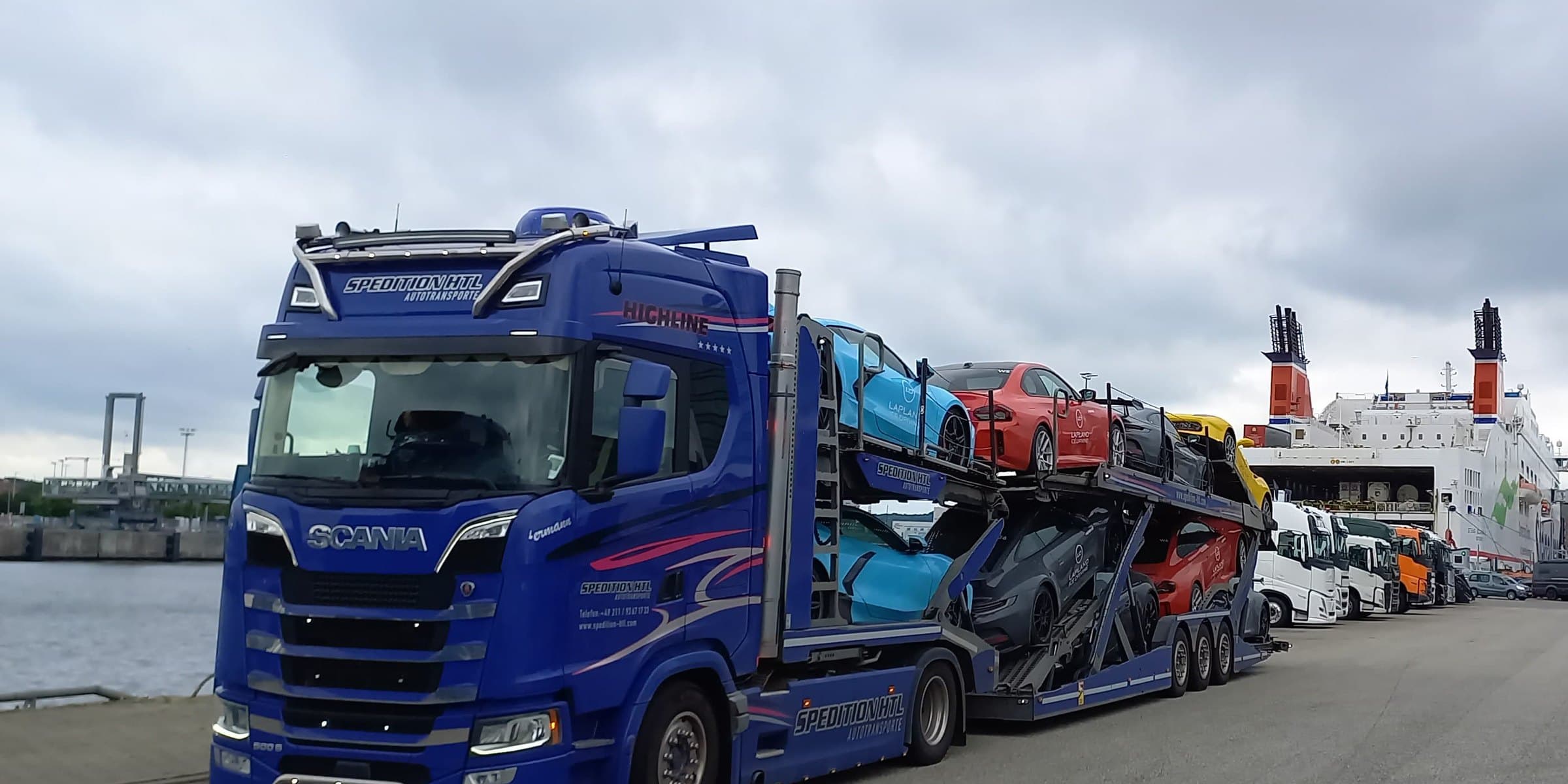
That is why, at Spedition HTL, the price per vehicle drops as soon as you entrust several on the same route, and why we favour direct delivery with no intermediate storage yard: fewer empty kilometres, less handling, less fuel per vehicle delivered.