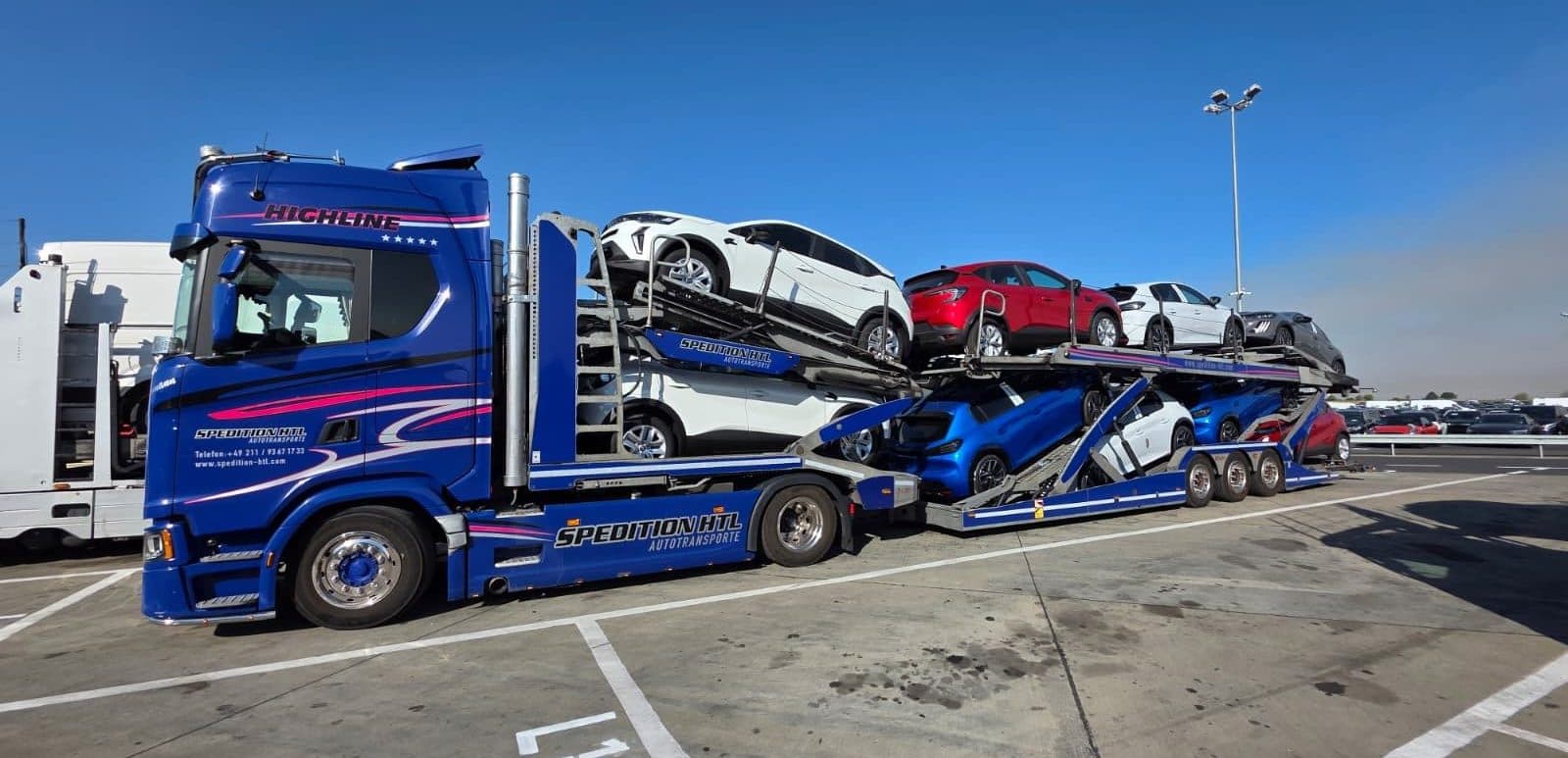
How many vehicles fit on a car carrier? The real numbers, model by model
· 6 min read · Updated on
It is the question that comes up most before a quote: “how many cars fit on a truck?” The honest answer is usually 8, between 3 and 9, and the difference does not come from vehicle length as is often assumed. Here are the real capacities we apply, taken from our own loading guide.
A vehicle’s overall size — height, length and width together — decides
A car carrier has two decks. The upper deck imposes a height limit of around 1,750 mm. A vehicle above that can only travel on the lower deck — where it takes a space two low vehicles would have shared.
The clearest example is the ID.Buzz: at 4.71 m long, a calculation based on deck length would suggest 7. But it stands 1,937 mm tall, so lower deck only, so 4 units in the short version and 3 in the long one. Any model based on floor metres alone gets it wrong.
That is why we work in slots rather than linear metres. The reference truck is worth 9 slots; a vehicle consumes 9 divided by its own capacity.
The real, measured capacities
These figures come from the loading guide we had produced in June 2026 for the Volkswagen range. They are measurements, not estimates — we apply them as they are when quoting.
City cars and compacts: Polo 9 · Up! 9 · Golf 8 saloon 9 · ID.3 9 · T-Cross 9 · Taigo 9 · Golf 8 Variant 8 · T-Roc 8.
SUVs and saloons: Tiguan 7 to 8 · ID.4 7 · ID.5 7 · Tayron 6 to 7 · Touareg 6 · Passat Variant 6 · ID.7 saloon 6 · ID.7 Tourer 5.
Vans and large volumes: ID.Buzz short 4 · ID.Buzz long 3.
Where a range appears, we always take the lower figure when quoting: a spare slot beats a vehicle left on the ramp.
What it actually changes in your price
The cost of a trip is the truck, the driver, the fuel and the tolls. It barely varies with what sits on top. The price per vehicle is that cost divided by the number of units loaded.
Direct consequence: nine Polos and five ID.7 Tourers on the same route cost roughly the same in total. The unit price differs by a factor of two. That is not an opaque rate card, it is geometry.
An extreme case worth knowing: a load made entirely of E-segment cars — large saloons and heavy SUVs — tops out around 5 vehicles. A surcharge applies on those, because the truck leaves with half its usable capacity.
How to use this when you order
Mix the sizes. A load of nothing but large SUVs is the most expensive per vehicle. Adding city cars to the same load fills the upper deck and brings down the unit cost of the whole load.
Consolidate on one route. The most effective lever is still the number of units on the same relation. Going from 3 to 8 vehicles on the same trip does not triple the price.
Give us the models, not just the count. “6 vehicles” is not enough to quote: 6 Polos and 6 Touaregs do not fill the same truck. Listing models on the quote request lets us answer accurately first time, within 2 working hours.