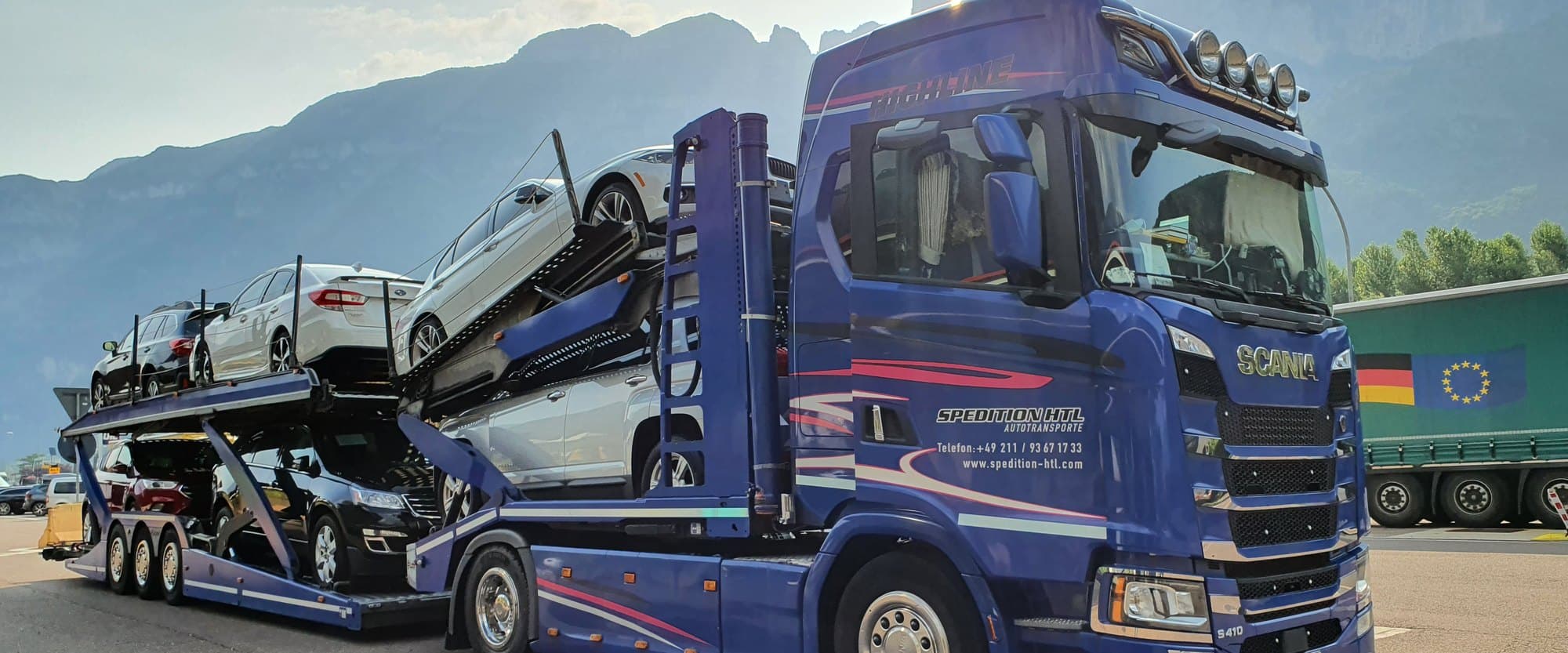
Customs clearance at your expense: how a car transport into or out of Switzerland works
· 6 min read
We serve Switzerland for both collection and delivery, almost always in connection with Germany. One thing differs from a transport between European Union countries: the border. This article explains what customs clearance at your expense means, what to have ready before collection, and what it changes — or does not — to the transit time.
What “customs clearance at your expense” means
Switzerland is not in the European Union: a vehicle crossing the border in either direction gives rise to customs formalities. With us, those formalities and any duties or taxes are at your expense: they are settled on your side, by you or by your customs agent.
This applies in both directions. For a delivery into Switzerland as for a collection in Switzerland bound for Germany, say when you ask who the declarant will be, you or your customs representative: it helps time the collection and the border crossing.
What happens at the border, in both directions
Into Switzerland, the vehicle is declared for export on the German side, then for import on the Swiss side. Depending on the vehicle’s status and origin, duties and taxes may apply on import into Switzerland, and proof of origin may be requested. Rules and rates change: check them with the Federal Office for Customs and Border Security (FOCBS) or your agent before setting a resale price.
Out of Switzerland it is the reverse: a Swiss export declaration, then import into the European Union with the corresponding VAT. To register an imported vehicle in Switzerland afterwards, the cantonal office generally asks for a document issued by customs (form 13.20 A): ask your customs agent for it at the time of import.
What to prepare before collection
Gather before the date: the identity of the customs declarant; the vehicle identification number (VIN); the invoice or proof of sale; the vehicle papers; proof of origin, if it applies. A document missing at the border is not settled at the roadside: it costs the whole load time.
State also the preferred crossing point — Basel and Weil am Rhein form a contact point between Germany and Switzerland — and the opening hours of the customs post, which your agent knows. These are practical details, not formalities, but they save a lost day.
Transit time: what the border changes
On the Germany–Switzerland corridor we state 1 to 2 working days between collection and delivery: that is the end-to-end time, not just driving time, and it is indicative, confirmed on the quote, never guaranteed. It assumes the formalities are ready at the crossing.
Do not confuse two subjects. Serving Switzerland — collecting or delivering there — is a regular service. Crossing Switzerland in transit, for example from Germany to Italy, is something else: as a rule our trucks avoid it because of the heavy-vehicle charge (LSVA) and use the Fréjus, the Brenner or Ventimiglia, unless the detour costs more. Our article on truck tolls 2026 details these charges.
One contact, one CMR contract
Our planning counts 47 trucks with our certified partners. HTL remains, in every case, the contractual carrier: liable under the CMR for every consignment, including those a partner drives, with one contact from quote to delivery. Five of these trucks are car carriers of our own, which we have run since 2014. Businesses (dealerships, traders, rental companies, import agents) are our main flow into Switzerland; private customers are accepted too, with priority given to trade flows. Describe your route in our request form: a reply within 2 working hours, with no commitment.