Car transport Germany–Italy: what decides between the Brenner and the Fréjus
· 7 min read · Updated on
Between Germany and Italy the schedule is not set by the mileage but by the Alpine crossing. Three crossings exist on the map; two structure our transport plans, the Brenner and the Fréjus tunnel, and the coastal route at Ventimiglia serves a southern departure. Switzerland appears on none of our itineraries as a rule. That choice governs the tolls involved, the driving bans to work around and, above all, the delivery date. Here is how dispatch decides, what shifts a trip on this axis, and what Spedition HTL, in Düsseldorf, commits to on this corridor.
Three crossings on the map, two in our plans
Three Alpine crossings exist on the map. Two structure our transport plans: the Brenner, through Austria, which opens the Italian north-east and the Po Valley, and the Fréjus tunnel, through France and Savoy, which suits the western side of the Po Valley. The third, the coastal route at Ventimiglia, earns its place when a trip already starts or reloads in southern France; the rest of the time it adds distance for nothing.
Switzerland, for its part, appears on none of our itineraries as a rule. That is a default routing rule, one that gives way only when the detour costs more than the LSVA — the Swiss heavy vehicle charge, for which the truck must be registered before any transit: without that registration it is stopped at the border. A stable rule, known to dispatch and drivers alike, is worth more than a decision reopened on every trip, which sooner or later produces a surprise at the border post.
It is generally the truck that stays out of Switzerland, not the customer. A principal based in Switzerland is served like any other, on the corridors we already run: the same dispatch, the same CMR consignment note, the same tracking link. The rule settles the itinerary, not the market — the two are regularly confused in the enquiries we receive.
What decides between the Brenner and the Fréjus
The delivery point decides first. A destination in Lombardy or the Veneto — Milan, Verona — runs over the Brenner, and Bologna follows the same logic. A destination in Piedmont or Liguria — Turin, Genoa — runs through the Fréjus. The difference in kilometres between the two routes rarely settles it on its own; which side of the Alps the delivery sits on does.
The loading point then adjusts it. A load collected in Bavaria or Baden-Württemberg pushes towards the Brenner even for a western destination: the truck is already on the right line. A load built in North Rhine-Westphalia or further west makes the Fréjus competitive again, all the more so when vehicles are picked up along the way.
Then comes the weather, which can reverse the choice. Snow on the approach roads, a closed pass, a seasonal closure or works in a tunnel are enough to move a trip onto the other crossing. None of that can be planned three weeks ahead: dispatch decides shortly before the departure day, with the day's information in front of it. The route is therefore not a customer option — what the quotation confirms is a collection window and an indicative transit time, not a crossing.
What shifts a trip on this axis
Austria regulates heavy goods traffic on the Brenner axis closely. Driving bans apply on certain days, and the Tyrolean Blockabfertigung — a cap on how many trucks per hour are released onto the approach road — is announced in advance by the authorities, on published dates. It is not a measure triggered by the day's congestion: it is a calendar, and it is checked before every departure rather than learned by heart.
Winter adds pass closures, snow, chain requirements on some sections and queues at the tunnel portals. A driver held up does not simply move on — he moves on with his driving and rest times. An hour lost in the afternoon becomes a delivery day moved. On this axis a shift of one to two days is a normal outcome of such events, not an outlier.
Hence our grid, stated as it stands: 3 to 4 days between confirmation of the quotation and collection, then 2 to 3 working days of driving towards Italy — against 1 to 2 on the northern corridors. Both are indicative, confirmed on the quotation and never guaranteed; on an Alpine corridor a guarantee would not hold. Two days of slack on the loading window let dispatch place your vehicles on a rotation already running and absorb a closure without rebuilding the trip.
What HTL commits to on this corridor
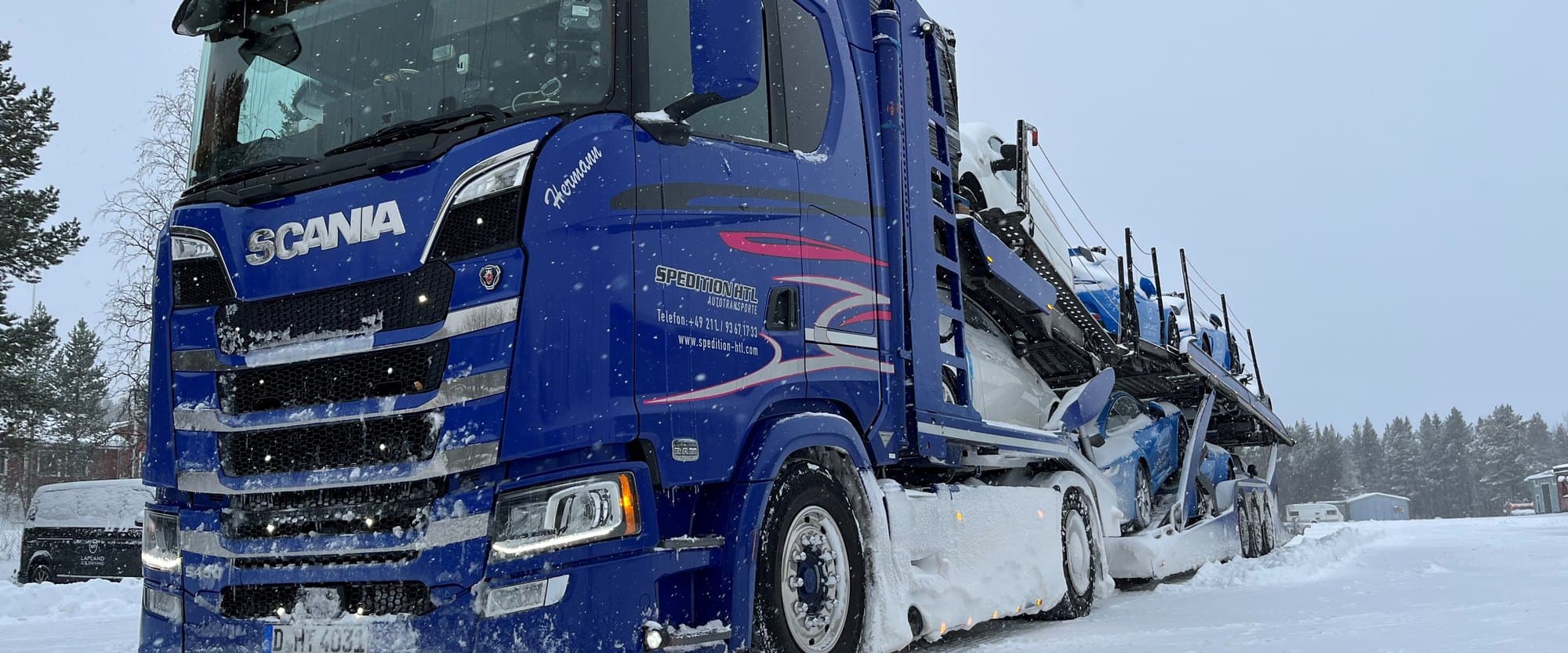
Spedition HTL, founded in 2014 and based in Düsseldorf, owns five car carriers. The daily planning moves considerably more with certified partners — around a hundred trucks as demand moves. Not all of your vehicles therefore travel on HTL equipment, and we prefer to write it down. What does not change is the contractual position: HTL takes the order and remains the contractual carrier — Frachtführer — liable under CMR on every consignment, including those a partner drives. A broker introduces two parties, hands the transport to a third and leaves the contract.
In practice: one dispatcher on the file from quotation to delivery; a CMR consignment note with a condition report, drawn up at collection and signed at delivery; and tolls costed into the quotation. The German Maut runs from €0.187 to €0.473 per kilometre depending on emission class and axle count; it is included, as are Austrian transit, the Fréjus tunnel toll and the Italian toll motorways — never billed on top afterwards. Regulatory framework: Community licence D-05-026-G-125, issued by the Bezirksregierung Düsseldorf.
Tracking follows the same restraint. Each transport gets one link, with no account and no password, and we state its limits up front: nothing is shown before loading — while the vehicles are not on board there is nothing true to show — and afterwards it gives a zone of roughly 10 kilometres, never an exact point. On an Alpine crossing that is the useful piece of information: it tells you whether the truck is still north of the Alps or already in the Po Valley. For anything else, a call to dispatch is faster than any map.